


News
Korean and Japanese Hydraulic Rock Breakers at the Best Prices – 0906 601 755
Sales of Hydraulic Rock Breakers Imported from Korea and Japan, with Weight Classes from 1 Ton to 4 Tons at the Best Prices. For inquiries, please contact 0906 601 755.
In projects with hard ground conditions, rocky formations, or where old concrete demolition is required, using a rock breaker—especially an excavator-mounted hydraulic rock breaker—helps save significant time and labor compared to manual methods. However, which breaker should you choose? A Korean hydraulic breaker or a Japanese hydraulic breaker? What size and weight class is suitable? Where can you buy from a reliable supplier? These are common questions raised by engineers and contractors.
In this article, Hanoi Vietnam provides an in-depth analysis of technical aspects, real-world performance, operating costs, and practical comparisons to help engineers and project owners make the right decision.
Key Advantages of Hydraulic Rock Breakers in Real-World Applications
A hydraulic rock breaker is a specialized attachment installed on excavators for operations in hard-structure terrains such as bedrock, reinforced concrete, old foundations, or geological layers that must be removed. Under Vietnam’s actual construction conditions—where many areas feature natural rock layers or require renovation and demolition—rock breakers are not merely supporting tools but critical equipment that directly determines project productivity and progress.
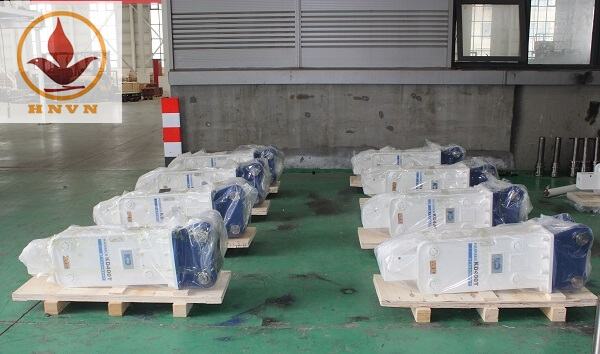
The operating mechanism of a hydraulic rock breaker is based on hydraulic compression: oil from the excavator’s hydraulic system is routed through hydraulic hoses into the breaker body, driving the piston under high pressure. As the piston repeatedly strikes the tool (typically made from high-strength alloy), impact energy is generated to fracture rock or concrete structures. As a result, the equipment can process a very large volume of material in a short time—work that would take many days and substantial manpower if done manually.
One outstanding strength of hydraulic rock breakers is their broad compatibility with excavators ranging from 1–3 ton mini excavators to large 30–40 ton machines. Mini breaker models such as KD400 and Soosan SB10 are suitable for confined spaces (residential areas, narrow streets) while still delivering strong breaking performance. Meanwhile, medium and large breakers such as NPK H-4X or Furukawa HB20G meet heavy-duty infrastructure demands—such as bridge foundation demolition, road works, and hydraulic structures—where rock is extremely hard and fast progress is required.
Two important factors in equipment selection are safety and fuel efficiency. Modern hydraulic breakers integrate safety valves and overload protection to prevent excessive pressure, extending the service life of both the breaker and the excavator’s hydraulic system. In addition, because the breaker uses hydraulic oil pressure rather than a separate engine, fuel consumption depends primarily on the excavator and does not significantly increase operating costs.
Another major advantage is easy maintenance and repair. With a precise yet not overly complicated mechanical structure, engineers can remove the piston, replace seals, and perform routine cleaning directly on site. Spare parts for Korean and Japanese hydraulic breakers are widely available in Vietnam, ensuring the equipment remains ready for operation with minimal downtime.
These advantages make hydraulic rock breakers essential equipment for modern construction, where schedule, productivity, and safety are top priorities. Whether for rock breaking during road opening, basement construction, factory foundation clearing, or demolition of old concrete structures, rock breakers consistently deliver superior efficiency compared to manual methods or light demolition tools.
Korean vs. Japanese Hydraulic Breakers: Which One Is Right for You?
In the hydraulic rock breaker segment for excavators, Korea and Japan currently hold the largest market shares in Vietnam. Each option has unique strengths depending on site conditions and budget. To help engineers and contractors make a well-informed investment decision, it is important to analyze technology, performance, service life, compatibility, and maintenance costs in detail.
1. Korean Hydraulic Breakers: Efficient Performance – Cost-Optimized Solution
Korean hydraulic breakers are widely used in small to medium projects where budget and construction progress must be balanced effectively. Leading brands such as Soosan, Komac, Jisung, and Hanwoo offer a broad product range from 150 kg to over 2,000 kg, suitable for most excavators from 1-ton mini units to 30–40 ton machines.
One of the greatest advantages of Korean breakers is competitive pricing, typically around 60–70% of the cost of comparable Japanese models. This allows contractors to optimize initial equipment investment, especially when purchasing multiple units or planning periodic replacement.
Brand-new Korean hydraulic rock breaker (100%)
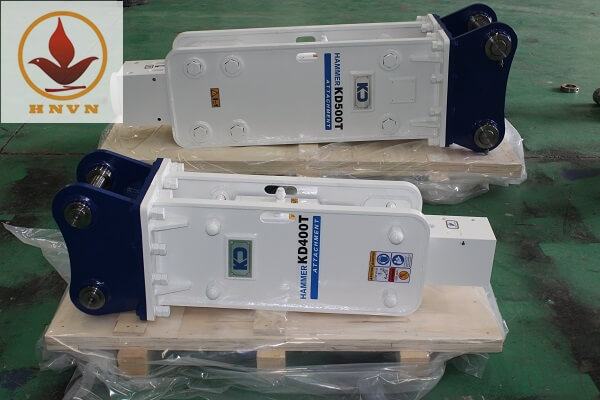
K400T hydraulic rock breaker manufactured in Korea
In terms of performance, Korean breakers provide stable impact power with blow rates of approximately 400–1,000 blows per minute depending on the model—sufficient for breaking sedimentary rock, porous rock, and reinforced concrete in civil works, internal roads, canals, and embankments.
A simple structure that is easy to disassemble and repair is another strong advantage. Most spare parts (chisels, seals, pistons, bolts, etc.) are readily available in the local market, helping reduce maintenance downtime—especially beneficial for remote job sites. In addition, some series such as KD series and SB series feature vibration-reduction designs, supporting operation in residential areas or near vibration-sensitive structures.
However, a limitation of Korean breakers is that mechanical durability may be lower than Japanese models when used continuously in extremely hard rock layers or in 24/7 heavy-duty operations.
2. Japanese Hydraulic Breakers: High Stability – Long-Term Investment
In the higher-end segment, Japanese hydraulic breakers are considered a reliable choice for large projects with strict technical requirements and long construction durations. Brands such as Furukawa, NPK, Okada, and Toyo are globally recognized for superior durability, premium materials, and stable long-term performance.
The greatest advantage of Japanese breakers is high service life and excellent operating stability. Impact energy is optimized, operation is smoother, and vibration is lower—helping protect the excavator’s hydraulic system. Certain models such as Furukawa HB20G and NPK E-210 integrate damping valves that reduce hose wear and minimize shock during sudden stops. This is especially important for projects requiring continuous breaking operations, such as underpasses, expressways, or industrial foundation rehabilitation.
In addition, Japanese breakers typically feature better heat dissipation design, reducing the risk of overheating in hot weather or during prolonged operation of 6–8 hours per day.
In terms of cost, although the initial investment is higher (around 30–40% more than Korean breakers), Japanese breakers usually last 1.5–2 times longer, experience fewer minor failures, and reduce long-term repair costs. This is why major project owners often choose Japanese breakers for key infrastructure projects.
The main drawback is that spare parts may be less widely available, and certain specialized components may require pre-ordering, which can cause delays without proper maintenance planning. However, as the spare parts market continues to expand, this issue is gradually improving.
Overall Summary: Should You Choose Korean or Japanese?
| Evaluation Criteria | Korean Hydraulic Breakers | Japanese Hydraulic Breakers |
|---|---|---|
| Price | Low to mid-range | Higher (~30–40%) |
| Durability / Service Life | Fair to moderate | High / long-lasting |
| Excavator Compatibility | Mini excavators up to 30 tons | Excavators from 10 tons and above |
| Breaking Capability | Good (soft to medium rock) | Excellent (hard rock, solid concrete) |
| Spare Parts Availability | Very available / lower cost | Less available / higher cost |
| Continuous Operation | Up to ~6 hours/day | Over 8 hours/day without overload |
| Maintenance & Repair | Easy, parts readily available | Requires higher technical expertise |
In summary, if you are a civil construction contractor with a limited budget and moderate site conditions, Korean hydraulic breakers are an economical and user-friendly choice. Conversely, for large-scale projects with complex rock layers requiring durable equipment for 24/7 operation, Japanese hydraulic breakers provide better long-term value.
Where to Buy Reliable Hydraulic Rock Breakers? Hanoi Vietnam – A Trusted Distributor
As hydraulic rock breakers are increasingly used in civil, transportation, and hydraulic projects, many engineers and contractors ask: “Where should I buy a breaker to ensure quality, clear warranty terms, and the best technical support?”
In today’s market, many suppliers offer rock breakers, from brand-new imported units to used Korean/Japanese units. However, not all sellers provide complete technical documentation, transparent warranty policies, or included spare parts. Purchasing low-quality products, incompatible models, or units that are difficult to maintain can lead to serious project delays and higher corrective costs.
Hanoi Vietnam is proud to be one of the leading professional providers specializing in imported hydraulic rock breakers from Korea and Japan, with proven field experience across hundreds of projects nationwide.
Reasons to Choose Hanoi Vietnam:
1. Genuine products with full documentation:
All Korean and Japanese hydraulic breakers supplied by Hanoi Vietnam are directly imported and come with CO/CQ certificates and anti-counterfeit labels. Customers can inspect equipment before payment to ensure it matches the technical configuration stated in the contract.
2. Wide range of models – ready stock in multiple sizes:
We supply breakers for all segments:
- Mini models: such as KD40, KD400 for PC20, PC30, PC50 excavators
- Mid-range models: such as Soosan SB50, Furukawa H4X, Komac KB1000
- Large models: such as Ripper Korea and Furukawa HB20G for 25–35 ton excavators
Ready stock is available in Hanoi and Ho Chi Minh City, helping shorten delivery time—especially critical for urgent projects.
3. On-site technical support – professional consultation:
Our engineers are not just sales staff—they are construction equipment specialists who can evaluate your excavator and recommend the most suitable breaker based on hydraulic pressure, oil flow rate, and impact energy requirements.
We also provide on-site installation and hydraulic parameter calibration to ensure stable operation and to prevent damage to the excavator’s hydraulic system.
4. Clear warranty policy and full spare parts availability:
Each hydraulic rock breaker comes with a manufacturer warranty of 6–12 months depending on the brand. Common consumables such as chisels, seal kits, and piston rods are always in stock, ensuring customers do not need to wait for overseas orders.
5. Competitive pricing – attractive discounts for bulk orders:
With direct import advantages and no intermediaries, we commit to offering the most competitive hydraulic breaker prices. For large contractors purchasing multiple units or planning periodic reinvestment, we provide strong discount and preventive maintenance programs.
Customer Feedback
- Mr. Huy (contractor in Quang Ninh): “I purchased two KD400 Korean breakers from Hanoi Vietnam for coastal rock embankment works. After installation, the units ran smoothly and the company’s technicians supported on site—very reassuring.”
- Minh Dung Company (Ho Chi Minh City): “We chose a Furukawa Japanese breaker for an overpass project. The upfront cost was higher, but we saved a lot of time and repair costs. Hanoi Vietnam delivered fast and provided full technical support.”
Contact Us for Consultation
Sales of hydraulic rock breakers imported from Korea and Japan, with weight classes from 1 ton to 4 tons at the best prices.
For inquiries, please contact 0906 601 755 — Hanoi Vietnam’s technical team is ready to consult, survey, and provide detailed quotations on site.
Popular Hydraulic Breaker Models at Hanoi Vietnam
With more than 10 years of experience in supplying construction equipment, especially hydraulic rock breakers, Hanoi Vietnam currently distributes over 20 different models, covering nearly all demolition and rock-breaking needs—from small civil projects to national key infrastructure developments. Products are directly imported from reputable brands in Korea and Japan, with full CO/CQ certificates and on-site installation support.
Below are some of our most popular rock breaker models, classified by size and compatible excavator class:
1. KD400 Breaker – Korea
- Breaker weight: ~300–400 kg
- Compatible excavators: PC30, PC40, PC50
- Highlights: A mini hydraulic breaker designed for small excavators, ideal for tight work areas such as narrow alleys, basements, and residential foundations. Compact design, stable impact power, and easy installation/operation.
- Applications: Slab concrete breaking, sedimentary rock breaking, residential foundation works.
- Advantages: Reasonable price, readily available spare parts, low operating costs.
2. Soosan SB43/SB50 – Korea
- Breaker weight: 500–750 kg
- Compatible excavators: PC60 – PC100
- Highlights: Mid-range breakers with stronger impact force, suitable for road works, rock embankments, and canal dredging projects.
- Applications: Medium-hard rock breaking, irrigation canal foundation clearing, large concrete block demolition.
- Advantages: Easy operation, strong durability, compatible with many excavator brands (used Japanese excavators, Hitachi, Komatsu, Hyundai).
3. NPK H-4X – Japan
- Breaker weight: ~1000–1100 kg
- Compatible excavators: PC120 – PC160
- Highlights: Low vibration, high mechanical durability, smooth operation—ideal for continuous work, especially in residential areas or near vibration-sensitive structures.
- Applications: Porous rock breaking, reinforced concrete demolition in overpasses, retaining walls, and large basements.
- Advantages: Low wear, fuel-saving, longer service life than comparable Korean breakers.
4. Furukawa HB20G – Japan
- Breaker weight: ~2000–2100 kg
- Compatible excavators: PC200 – PC300
- Highlights: A heavy-duty breaker for boulder breaking and deep hard rock excavation. High impact energy, robust design, stable performance even in 24/7 operations.
- Applications: Expressways, underpasses, elevated rail, quarry rock breaking.
- Advantages: Very high reliability, consistent productivity, minimal downtime.
5. Ripper Korea – Korea
- Breaker weight: 1800–2300 kg
- Compatible excavators: PC200 – PC350
- Highlights: Not a typical breaker but a specialized rock ripping attachment that works like a ripper tooth to tear and split extremely hard layers. Used when rock is too hard for conventional breakers.
- Applications: Quarry trenching, small mining operations, breaking monolithic granite and basalt layers.
- Advantages: 2–3x more effective than conventional breakers in extremely hard rock, reduced tool wear.
Summary Table of Best-Selling Breaker Models at Hanoi Vietnam
| Model | Origin | Breaker Weight (kg) | Compatible Excavator Class | Main Applications |
|---|---|---|---|---|
| KD400 | Korea | 300–400 | PC30 – PC50 | Civil works, slab concrete breaking |
| SB43 / SB50 | Korea | 500–750 | PC60 – PC100 | Road works, rock embankments |
| NPK H-4X | Japan | 1000–1100 | PC120 – PC160 | Overpasses, urban projects |
| Furukawa HB20G | Japan | 2000–2100 | PC200 – PC300 | Expressways, deep rock breaking |
| Ripper Korea | Korea | 1800–2300 | PC200 – PC350 | Mining, hard granite rock |
Choosing the right hydraulic rock breaker directly impacts project progress and helps protect the excavator, reduce hydraulic failure risks, and minimize unexpected repair costs. Hanoi Vietnam’s technical team is always ready to recommend the most suitable breaker based on ground conditions, available excavator specifications, and customer budget.
Contact 0906 601 755 for detailed consultation and quotations for each model based on your actual construction requirements.
Practical Tips for Selecting the Right Breaker for Your Project
Selecting the right hydraulic rock breaker affects demolition efficiency, excavator durability, operating costs, and overall project schedule. Many engineers and contractors face challenges due to the variety of models, brands, and specifications available—especially without a clear understanding of site requirements.
Below are practical recommendations based on hundreds of projects implemented by Hanoi Vietnam to help you choose the right Korean or Japanese hydraulic breaker.
1. Based on Ground Type and Materials to Be Broken
First, identify the material to be demolished: soft sedimentary rock, regular concrete, reinforced concrete, or natural rock such as granite or basalt?
- For soft rock, precast concrete, and floor slabs, mini breakers such as KD400 or SB43/SB50 are typically sufficient for fast demolition without overloading the excavator.
- For medium to hard rock layers such as limestone, bedrock, bridge foundations, or factory base slabs, larger breakers such as NPK H-4X or Furukawa HB20G are recommended to maximize productivity and reduce working time.
- For extremely hard rock or rock with embedded rebar, a ripper attachment such as Ripper Korea is often the best option, minimizing tool wear and protecting the excavator.
2. Match Breaker Size to Excavator Power and Hydraulic Configuration
A common mistake is selecting a breaker that is too large or too small for the excavator. This reduces breaking efficiency and can cause serious damage to the excavator’s hydraulic system, especially on older used machines.
Before purchasing, check these key parameters:
- Hydraulic oil flow rate (L/min): typically 25–120 L/min depending on breaker size.
- Operating pressure (bar or MPa): the breaker and excavator must match to avoid overpressure or low pressure that may damage the piston or weaken impact force.
- Breaker weight (kg): avoid selecting a breaker heavier than the excavator arm/bucket capacity to prevent structural stress on boom, arm, and undercarriage.
Example: PC60–PC70 excavators typically match 500–800 kg breakers; PC120–PC160 match ~1,000–1,200 kg breakers; PC200–PC300 can mount 1,800–2,300 kg breakers.
3. Define Your Working Pattern: Continuous or Intermittent?
For projects requiring continuous daily operation such as expressways, underpasses, and ports, Japanese hydraulic breakers are recommended due to stable performance, lower vibration, fewer failures, and better fuel efficiency.
For intermittent work or frequent relocation such as residential foundation demolition, scrapyard clearing, or civil site preparation, Korean breakers are often more suitable thanks to reasonable price and easy maintenance.
4. Consider Maintenance and Spare Parts Availability
Spare parts availability is often overlooked. Even if a breaker performs well, lacking replacement parts can lead to days of downtime and serious schedule delays.
- Korean breakers offer strong advantages: common parts, lower cost, easy procurement.
- Japanese breakers require a supplier with ready stock or committed maintenance support programs.
Hanoi Vietnam maintains a full spare parts inventory for both Korean and Japanese breakers, along with on-site maintenance support within 24 hours for customers in major provinces and cities.
5. Choose a Supplier That Provides Full Technical Support
Beyond specifications, the supplier’s technical capability is critical. Some breaker models require hydraulic system adjustment, hose connection modifications, or pressure calibration. Improper setup may cause cylinder damage, valve failure, or hydraulic pump burnout.
At Hanoi Vietnam, all customers receive:
- Consultation to select the correct model for the excavator
- Installation support and on-site parameter calibration
- Hydraulic leak checks and maintenance guidance after the first 100 operating hours
Conclusion
- Korean hydraulic breakers are suitable for civil works, moderate budgets, and easy spare parts availability.
- Japanese hydraulic breakers are ideal for large-scale projects requiring high durability and stable operation.
- When selecting a hydraulic breaker, focus on weight class, hydraulic pressure, excavator compatibility, and maintenance capability.
- Hanoi Vietnam is a trusted supplier of genuine hydraulic rock breakers, offering full technical support and competitive pricing.
Hydraulic Rock Breaker Images
Below are hydraulic rock breakers from Korea, Japan, and China available from our company:
Hydraulic Rock Breaker Chisel Pin Installation Procedure
Guide to Installing and Testing Korean Hydraulic Rock Breakers
User Guide: Installation and Operation of Excavator-Mounted Hydraulic Rock Breakers
In addition, you may refer to our concrete pile hammers currently available at Hanoi Vietnam Construction Machinery.
*Liên hệ nhận thông tin và báo giá: https://mayxaydunghanoi.click/
